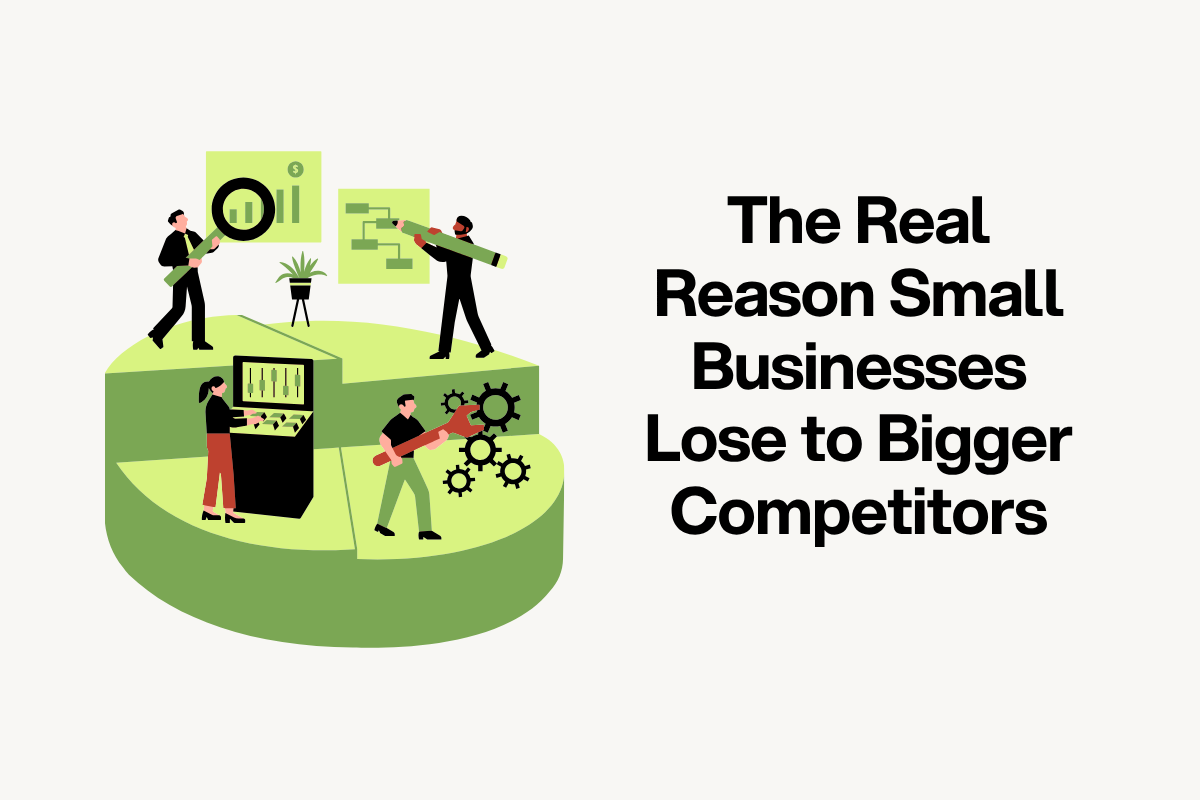
The Real Reason Small Businesses Lose to Bigger Competitors
Small businesses lose not because of budget or talent gaps but because of infrastructure gaps. Here is how the right systems let smaller teams compete above their weight.
Ask the owner of a small business why larger competitors win and you will hear familiar explanations. They have more money. They have bigger teams. They can outspend us on marketing. They have brand recognition we cannot match.
These explanations feel true. They are also mostly wrong.
The consistent advantage that larger businesses hold over smaller ones is not financial or reputational. It is structural. Larger companies have infrastructure: systems, processes, and platforms that allow them to operate at scale with consistency. When a prospect compares a ten-person firm with a fifty-person firm, the difference they notice is not headcount. It is the experience of interacting with each one. One feels organized, responsive, and professional. The other feels scattered.
The critical insight is that infrastructure does not require size. A ten-person company with the right systems can deliver an experience that matches or exceeds what a fifty-person company without them provides. The competitive gap between small and large businesses is not a size gap. It is an infrastructure gap. And infrastructure is a problem that can be solved.
The Infrastructure Gap: What It Is and Why It Matters
Infrastructure, in a business context, refers to the operational systems that enable consistent execution. This includes how clients are onboarded, how projects are tracked, how invoices are generated, how communication flows, how data is stored and accessed, and how recurring processes are managed.
Large companies have this infrastructure because they were forced to build it. When a company hits a hundred employees, it cannot rely on informal coordination. It needs project management platforms, CRM systems, standardized communication protocols, documented processes, and centralized data. The alternative is chaos.
Small companies often skip this investment because they can. With five or ten employees, informal coordination seems to work. The founder knows every client. The team communicates through group chats and hallway conversations. Invoices are generated from a spreadsheet template. Client records live in a combination of email threads, notes apps, and individual memory.
This works until it does not. And when it stops working, the consequences are competitive, not just operational.
A prospective client evaluating two firms, one large and one small, does not see headcount. They see the proposal format, the response time, the onboarding process, the reporting cadence, and the communication quality. The large firm with infrastructure delivers these consistently because systems ensure consistency. The small firm without infrastructure delivers them inconsistently because consistency depends on individual effort, and individual effort varies.
The prospect does not think "the large firm has better systems." They think "the large firm is more professional." They are drawing a conclusion about competence from evidence that is actually about infrastructure. And they choose accordingly.
How Big Companies Appear Big
There is a revealing exercise in competitive analysis: strip away the brand name and headcount from two competing firms and evaluate them solely on the client experience they deliver. What you often find is that the perception of size is created by systems, not people.
A company that sends an automated but personalized acknowledgment within two minutes of receiving an inquiry appears responsive and well-staffed. A company that responds manually four hours later, even if the response is more thoughtful, appears either busy or disorganized.
A company that provides a client portal with real-time project tracking, document sharing, and milestone visibility appears sophisticated and resource-rich. A company that sends weekly status update emails compiled manually from team check-ins appears smaller and less capable.
A company whose invoices are branded, detailed, and arrive automatically on a predictable schedule appears established. A company that sends plain invoices from a spreadsheet template, occasionally late, appears less professional.
A company with a structured onboarding process, including welcome emails, intake forms, kickoff meeting agendas, and timeline documents, all triggered automatically, appears to have handled hundreds of clients. A company that wings the onboarding based on the founder's personal approach appears to be figuring it out as it goes.
In each case, the perceived size and sophistication of the business is determined by infrastructure, not headcount. The automated acknowledgment does not require a receptionist. The client portal does not require a project management department. The branded invoices do not require a billing team. The structured onboarding does not require a client success division.
These systems can be built and maintained by a small team. What they communicate to clients is the experience of working with a much larger one.
The $200K Business With Systems Versus the $500K Business Without Them
Consider two real scenarios that play out in service industries daily.
Business A generates $200,000 in annual revenue with three full-time employees. It has a centralized client management system that tracks every interaction, automates follow-ups, and generates invoices on completion. Client intake is a structured form that feeds directly into the project pipeline. Status reports are generated automatically from project tracking data. The founder spends 70% of her time on client work and business development.
Business B generates $500,000 in annual revenue with eight full-time employees. Client information is spread across email threads, shared drives, and a basic spreadsheet. Follow-ups depend on individual team members remembering to send them. Invoicing is a manual process that an office manager handles, typically running two to three weeks behind. The founder spends 60% of his time managing internal operations, resolving miscommunications, and putting out fires.
Business A operates at higher margins because its infrastructure eliminates waste. Business B operates at lower margins because its lack of infrastructure creates waste: missed follow-ups that lose opportunities, billing delays that hurt cash flow, miscommunications that require rework, and founder time consumed by operational management rather than revenue generation.
Business A can grow to $500,000 in revenue by adding two people and scaling its existing systems. Business B would need to hire another three to four people to grow to $1,000,000 because its processes scale linearly with volume.
The counterintuitive lesson is that revenue is a poor indicator of business health. Operational infrastructure determines whether revenue translates into profit, scalability, and sustainability, or whether it simply creates a larger, more chaotic organization.
The Scalability Trap
Growth is a trap for businesses without infrastructure. Every new client, employee, or service line adds complexity. Without systems to manage that complexity, each addition creates a disproportionate increase in coordination costs, error rates, and management overhead.
This is what operations researchers call the "complexity penalty." A ten-person company that doubles its headcount without upgrading its infrastructure does not get twice the output. It gets less than twice the output with more than twice the coordination burden.
The math works like this. In a team of five, there are ten possible communication channels between individuals. In a team of ten, there are forty-five. In a team of twenty, there are one hundred and ninety. Communication complexity grows exponentially while capacity grows linearly. Without infrastructure to structure communication and workflow, growth actually reduces per-person productivity.
This explains a phenomenon that mystifies many founders: the company was more productive and more profitable when it was smaller. Growth was supposed to create economies of scale. Instead, it created diseconomies of coordination.
The scalability trap catches businesses that grow revenue successfully but fail to invest in the operational infrastructure to support that growth. They hire more people to handle more work, but without systems, each person adds communication overhead, introduces variability, and increases the management burden on leadership.
Eventually, the business hits a ceiling. Not a market ceiling, since there is plenty of demand, but an operational ceiling. The organization cannot process more work without unacceptable quality degradation, timeline slippage, or employee burnout. Growth stalls, not because the market stopped buying, but because the business stopped scaling.
How to Compete Above Your Weight Class
Small businesses have inherent advantages that infrastructure amplifies. They are faster to make decisions. They are closer to their clients. They can customize and adapt in ways that large organizations cannot. The problem is that without infrastructure, these advantages are negated by inconsistency, disorganization, and capacity constraints.
Infrastructure changes the equation. A small firm with systems can combine its inherent advantages with the consistency and professionalism that clients associate with larger firms. Here is how.
Centralize client data. Every interaction, document, note, and transaction associated with a client should live in one place. This eliminates the information fragmentation that makes small teams appear disorganized and ensures that any team member can step into any client relationship with full context.
Automate the repetitive. Welcome emails, appointment reminders, invoice generation, status updates, follow-up sequences. Every recurring communication that can be triggered by an event or a calendar date should be automated. This creates consistency that clients notice and frees team members to focus on work that requires human judgment.
Standardize your deliverables. Templates for proposals, reports, onboarding documents, and project plans ensure that every client receives a consistent, professional experience regardless of which team member is leading the engagement. Standardization does not mean generic. It means establishing a quality baseline that can be customized where it matters.
Build a client-facing portal. Even a simple one. The ability for a client to log in, see their project status, access documents, and communicate through a branded platform creates a perception of organizational maturity that email threads cannot match.
Invest in your intake process. The transition from "prospect" to "client" is a high-stakes moment. A structured intake process, with defined steps, automated communications, and clear expectations, sets the tone for the entire relationship. It tells the client: you are in professional hands.
Measure and iterate. Systems generate data. Use it. Track response times, project completion rates, client satisfaction scores, and revenue per client. The businesses that compete above their weight class are the ones that use data to continuously improve their operations rather than relying on gut feel.
Why Throwing People at Problems Does Not Scale
The default response to operational challenges in small businesses is to hire. The workload is overwhelming, so the solution must be more hands. This instinct is understandable but often counterproductive.
Hiring without infrastructure means adding capacity and complexity in equal measure. Each new employee needs to be managed, communicated with, and coordinated. Without systems, the management overhead of each new hire can consume 30% to 50% of the capacity they are supposed to add.
There is a thought experiment that illustrates this. Imagine a task that takes one person one hour. If you assign two people without a system to coordinate them, the task might take forty minutes, because coordination consumes twenty minutes of the theoretical thirty-minute savings. Add a third person and the task might take thirty-five minutes because coordination costs are now consuming most of the marginal capacity.
This is not hypothetical. Fred Brooks documented this phenomenon in 1975 in "The Mythical Man-Month," observing that adding people to a late software project makes it later. The principle applies far beyond software. Any complex operation where coordination costs are high will experience diminishing returns from additional headcount without structural improvements.
The alternative is to invest in infrastructure that multiplies the effectiveness of existing headcount. A system that automates client communication does the work of an additional team member without the salary, management overhead, or coordination cost. A centralized dashboard that gives every team member real-time project visibility eliminates the status meetings that consume hours each week.
The most competitive small businesses are not the ones with the most employees. They are the ones with the highest output per employee. And output per employee is a function of infrastructure, not effort.
Closing the Gap
The infrastructure gap between small and large businesses is not inevitable. It is a choice. And for the first time in business history, the tools to close that gap are accessible to companies of any size.
A decade ago, building the kind of operational infrastructure that large companies had required large company budgets: six-figure enterprise software licenses, dedicated IT departments, and months of implementation. Today, the options range from configurable platforms to custom-built systems that can be deployed in weeks rather than months.
The question for small business owners is not "Can we afford operational infrastructure?" It is "Can we afford to compete without it?" When your prospect is comparing your proposal with one from a larger competitor, they are not evaluating you on size. They are evaluating you on experience. And experience is a function of systems.
The businesses that close the infrastructure gap discover something surprising: they were never at a disadvantage because they were small. They were at a disadvantage because they operated like they were small. Remove that constraint, and the inherent advantages of being small, including speed, proximity, flexibility, and personal attention, become the competitive weapons they were always meant to be.
Keep Reading
For more on how owning your systems creates lasting competitive value, see our article on Own Your Infrastructure: Why Proprietary Systems Increase Business Value at /news/own-your-infrastructure. You can also read The Businesses That Survive the Next Five Years Will Have One Thing in Common at /news/businesses-that-survive-next-five-years for a broader look at the operational patterns that separate thriving companies from struggling ones, or explore Why Your Best Employee Is Doing Work a System Should Handle at /news/best-employee-doing-work-system-should-handle for the hidden cost of manual processes.